 The Canadian Real estate market managed to burn red through the 2008 recession and is expected to keep burning even though the oil is running low.
The historically low interest rates of the past years have helped to sustain demand through the recession and mitigate the impact of tightened lending criteria. Now, with the Bank of Canada (BOC) lowering rates once again in the wake of dangerously low oil prices, it seems we will be keeping with tradition for 2015. While the BOC has hinted towards a rate hike in 2015, it is unlikely given the exceptionally low price of oil and the negative impact a hike could have on Canada’s grander export driven economy. This is of course good news if you’re a homeowner, and bad news if you’re looking to buy. Yes indeed, it looks as though Canada will remain a sellers market for the foreseeable future.
The following are what I have been able to surmise from various North American housing reports and forecasts – many of which I will list for your reference at the end.
2014 in review
Last year much of eastern Canada witnessed an excess of homes entering the market, which in turn gave buyers the upper hand. While I’m sure this trend was a welcome relief from what had previously been a strong sellers market, such relief was not extended to urban centers such at the GTA, Calgary and Montreal, which saw continued strong demand underpinned by millennials looking to take advantage of exceptionally low rates. The unseasonably high demand moving into the summer seasons was in part due to the horrific winter, which stalled both buyers and sellers from entering the market until late spring. The resulting market influx was then carried throughout the summer and into the fall.
Canadian Outlook
In its Q4 housing report the CMHC predicts BC and Quebec will only see moderate supply growth moving forward. As builders in more price vulnerable suburban areas, and provinces such as Quebec and BC encounter greater economic uncertainty due to interest rate volatility and currency fluctuations, builders will cut back on housing starts to bring inventory levels under control. This will serve to further fortify prices against a potential decline in demand.
Though the fall in oil prices may be putting western Canadian homeowners on ice, I wouldn’t be looking to cash out any time soon for the following three reasons:
- Calgary is a one-industry town and is subject to the wrath of the globally dictated and often volatile price of oil. Over the course of its existence Calgary has been subject to a litany of such fluctuations (one every ten years or so) and has always managed to come out on top. Calgary and its more weathered citizens know that these things come and go like a summer storm – you simply have to sit tight and hold it out.
- The price of oil is not subject to market fluctuations in the way most other commodities are – It’s largely decided by a bunch of guys sitting around a table in the Middle East trying to use their colossal oil reserves and political prowess to push the price of oil in a direction they feel most beneficial. Though, whether they like it or not, the available supply of oil will ALWAYS be dwindling, and the demand for oil will ALWAYS be increasing – especially as the world becomes more equal and globally developed. So, you can try and influence prices whichever way you want, but in the long run prices will always be rising until we figure out some cost viable alternative.
- Calgary, and Canada as a whole have been getting the sharp end of a bad deal ever since it decided to start using foreign refineries and selling oil as a resource export almost exclusively to the United States. However, should any of the major pipelines such as the Northern gateway or the Keystone get pushed through (and I’m sure one of them will), the deal will start to get a lot sweater for those in the north.
Toronto Outlook
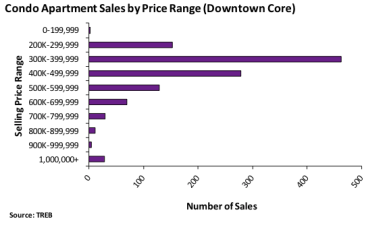
Toronto Real Estate Board Condo Market Report
In Toronto and other urban centers millenials and new homebuyers alike are fighting tooth and nail to get into the market before the Bank of Canada raises interest rates, and the housing supply for 2015 looks only barely capable of satisfying demand.
Because the price of single family homes are continuing to rise, they are becoming a less and less viable option for new families looking to remain in urban centers. New homebuyers with families are therefore looking to the condo market to search for more affordable options. Compensating for the increased condo demand will be the thousands upon thousands of condo units entering the market every year in urban centers such as Toronto, Calgary and Vancouver.
Last year, Toronto saw condo sales increase 6% to 370k and prices by 4% to roughly $370k. Conversely, the relative restricted supply of semi and detached homes rocketed the average price by a precedent setting 13% in 2014 to an average selling price of $702k. Though condos remain a good deal, buyers will still prefer hard land, which is in exceedingly short supply. Therefore the seemingly exponential price increase of single-family dwellings is expected to continue into 2015, though a return to double digit is unlikely.
While analysts foresee housing prices either leveling with inflation or eventually declining, many agree 2015 will be another year of both steady and solid growth.
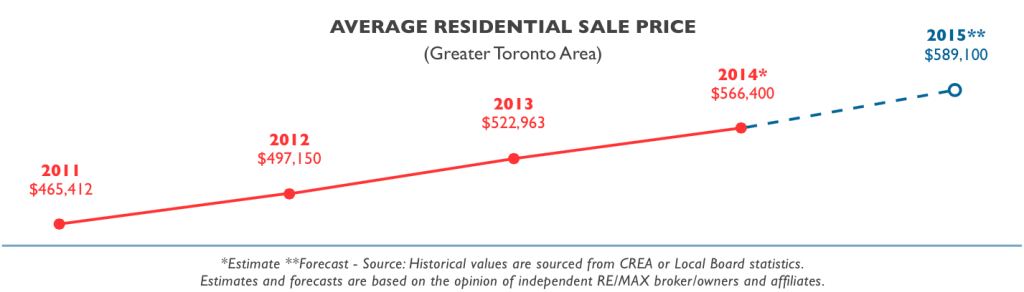
With a continued relatively low interest rate outlook and a stronger, more stable political environment in Ontario, it looks as though we can expect more realistic and stable home prices moving into 2015; reassuring buyers that their high prices aren’t just inflating a bubble.
Potential minor disruptions to the market might include:
The Pan Am Games: The Pan AM games will place Toronto in a fairly bright spotlight which, depending the image Toronto manages to put forth, could encourage more international investors to consider including Toronto in their portfolio. Such a demand spike would however be very short lived and likely diminish with the fall weather.
The weather: Last year Toronto, along with the rest of Canada, experience one of the worst years for weather. It was cold well into May, and the summer was more comparable to previous spring seasons than summers. It could very well be that skeptical sellers looking to get top dollar are waiting for more optimal market conditions which could very well arrive this summer. Should Toronto encounter a summer more consistent with the norm, 2nd and 3rd quarter sales could present stronger than years previous as the already cyclical high of the summer season is compounded by sellers entering the market who had been patiently waiting on the side lines.
A small interest rate hike: While unlikely, a small interest rake hike could be justified should oil prices recover to 2014 Q1 and Q2 prices.
In January 2015 the Governor of the Bank of Canada, Stephen Poloz, decreased its over night interest rate target from an already low 1% to a 4 year low 0.75% to compensate for falling oil prices in an already fragile economy. While this reduction will have little if any noticeable impact on consumer interest rates, should oil prices recover, the BOC may look to set interest rates back to 2014 Q4 rates, which would mean the first ever increase in interest rates of the past four years. This directional change from decrease to increase, however minimal it may be, might scare potential buyers and encourage sellers to get into the market before it cools down.
Economic Outlook
The consensus looks to remain one of stability throughout 2015. Despite low oil prices, small gains in employment and wages are anticipated to realize a moderate growth of 2.5% – much the same as it was in 2014.
Ontario’s manufacturing industry relies heavily on access to capitol and attractive prices to American consumers. Ontario businesses are therefore well positioned to take full advantage of precedent setting lending rates and will benefit greatly from a weak Canadian dollar. Measures taken by the Bank of Canada to aid struggling Canadian industry in the west and east will both prevent the Canadian economy from another economic slump and re-inforce Ontario’s manufacturing industry as a viable option for companies looking to set up North American operations.
For further reading I highly recommend the following:
Canadian Mortgage and Housing Corporation Outlook
Bank of Canada archive and query database
Re/Max Housing Market Outlook Report
 Property Prophet